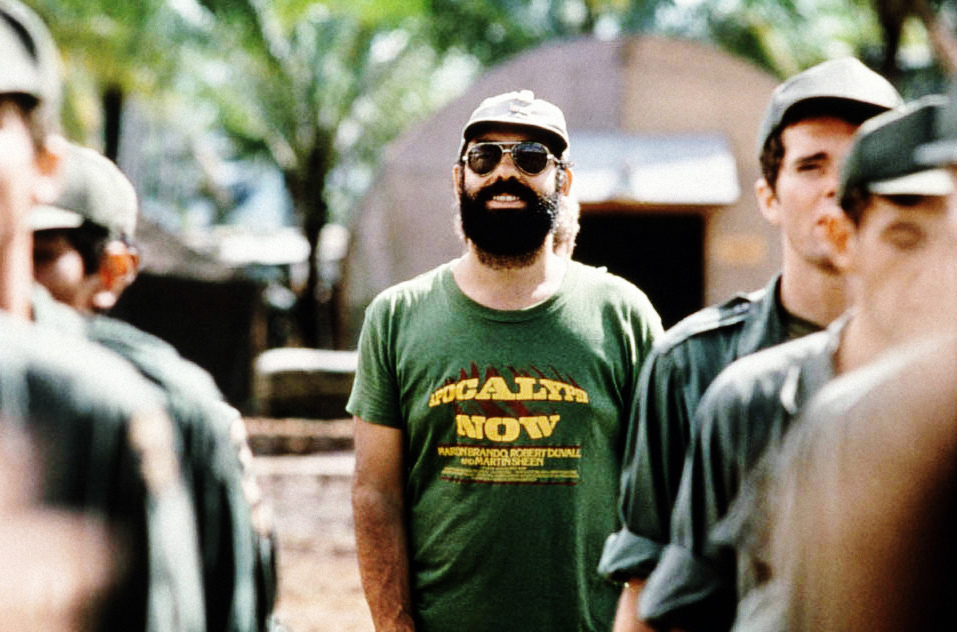
“We were in the jungle, there were too many of us, we had access to too much money, too much equipment, and little by little we went insane.”
I decided to watch a kickass documentary called Hearts of Darkness on Friday afternoon. The doc is about the making of Francis Ford Coppola’s timeless war epic Apocalypse Now. Usually, I can pass on a documentary about the making of a movie because it seems a bit overindulgent, but I made an exception for this one.
The documentary was shot by Francis’ wife, Eleanor, who accompanied her children to the Philippines to capture behind-the-scenes footage. (A 4-year-old Sofia Coppola even makes a cameo.) The film showcases the renowned movie director (of the Godfather trilogy) shooting a war movie with a massive budget and an equally ambitious vision.
Everything that could go wrong did. The film was budgeted at $20 million (a huge Transformers-like budget for the late ’70s), but once the production started to go over, Coppola had to put up his own money to make it work.
He basically invested every cent he had made into the film, much like he would with Megalopolis. And then things started to go even farther downhill.
A few weeks into shooting, Coppola had a dream, which led him to fire Harvey Keitel, the lead actor. Then he jetted out to LA, met and hired Martin Sheen, and they flew back to the Philippines to basically reshoot the last 3 weeks of filming.
A 36-year-old, three-pack-a-day-smoking Martin Sheen gets to set and is pushed to his limits physically and emotionally during filming. One day, Sheen starts getting chest pains, crawls toward a bus stop, and proceeds to have a massive heart attack.
They hush up the set because if Hollywood finds out that the lead actor in a $20+ million movie, which is two months into production, is about to pass away, the studio will likely pull the plug. They try to shoot around Martin until he recovers, which proves impossible since he appears in almost every scene in the movie. Then the weather turns against them and a giant typhoon hits the area where they are shooting, destroying the set and causing production to be shut down for 2 months while it is rebuilt.
This is where Coppola begins his descent into slight madness. The man’s lost 40 lbs in 2 months, is having psychic dreams and suicidal thoughts and the future of his movie is questioned.
Eleanor Coppola, who understands what viewers really want, sets up recorders in their room to videotape Francis’ mini breakdowns. He’s heard saying how he thinks the movie is really bad, that he doesn’t know what he’s doing, and that he is scared to death of the outcome.
Meanwhile, the actors on set are smoking reefer, dropping acid, doing speed, and drinking excessively. For better or worse, they have become their characters.
Then, Mr. Marlon Brando arrives on the set. He promised Coppola he would lose weight because he is playing “Kurtz,” a man who has fallen from military grace and is living deep in the Cambodian jungle, commanding his own army.
Living in the Cambodian jungle would mean having no access to cakes, pies, donuts, and bacon. Marlon, himself, could not cut those things out to return to form. Coppola tries to compromise, telling Brando that maybe his character has decided to become a hedonistic glut, taking multiple ladies as lovers, and being fed rich fruits all day.
Brando declined because he was shy about his weight and wanted no attention called to it. His only homework assignment was to read Joseph Conrad’s Heart of Darkness, the book the movie was loosely based on—but he doesn’t. Brando is charging Coppola $3 million for three weeks of work, while using a significant portion of that time to discuss his character with Coppola during precious shooting time.
He wouldn’t give Coppola time to rewrite the script, so the director decided to let him improvise his entire part. This leads to nonsensical rambles and wasted days.
They finally film the meeting between Sheen and Brando, but Coppola is left unsatisfied. Sheen’s character is sent to kill Brando’s, but you get the feeling that Coppola never quite got the performance that he needed to illustrate the tension in that major scene. They shoot for a few more days, and then the production wraps after 238 days of shooting.
Two years later, the movie is released. It goes on to gross over $150 million, and Coppola retains his title as one of the greatest directors of all time who makes a delicious Chardonnay.
There is a scene near the beginning of the movie where Martin Sheen is in his hotel room, and he appears to have lost his mind. He punches a mirror, and it catches on his thumb, and he begins to bleed. He asks for the cameras to keep rolling, and you hear Coppola in the background telling him to think about his home and his family. Then Sheen has a complete breakdown.
Coppola later explains that watching a man go that deep into himself was scary and fascinating. Yet, by the end of this documentary, you get the feeling that Coppola was never satisfied with the outcome. He suffered greatly for a near-perfect film. Madness, determination, desire and suffering combined to make one of the most bizarre, accurate, and cutting war films of all time.
I got a few amazing takeaways from this movie. Coppola is an intense and amazing director responsible for some of the best performances in film history. Brando was an unpredictable but talented actor, and Martin Sheen is a great actor and a complete badass. Now I must smoke some peyote, throw on an old Doors album and then watch Apocalypse Now. Thank you, Mr. Coppola.
 Danger Bowie
Leave a comment