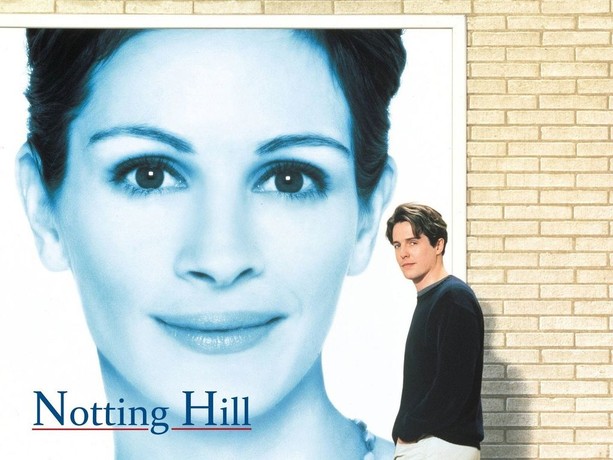
When Notting Hill hit theaters on May 28, 1999, I was already predisposed to fall for it. A charming British bookseller, a world-famous American actress, a quirky ensemble of friends, all set in one of the most romantic corners of London. What chance did I have?
Twenty-six years later, I still love this iconic rom-com. But not for the reasons I used to. Rewatching it now, what surprises me most isn’t how much I still enjoy it, but how much I’ve come to accept that the central romance, the supposed heartbeat of the movie, may be the weakest part. I know, I know, but hear me out.
Anna Scott, played by Julia Roberts, is a somewhat one-dimensional character, drawn almost entirely from the outline of her fame. She flits into William Thacker’s life with a soft smile and few actual conversations. She kisses him out of nowhere after knowing him for maybe 8.5 minutes. She continues to see him while still entangled with her boyfriend, which the movie treats as a minor hiccup rather than the huge red flag it is.

She then disappears, reappears, lashes out and disappears again without ever really taking responsibility for the whirlwind she’s created. Anna’s messy in a way that would send most people running in the real world.
And Will? He’s sweet and understanding, but almost to a fault. He lets these things happen to him without much protest. It’s not until he finally says no near the end of the film that he shows a flash of self-respect, but the rom-com formula requires reconciliation, no matter how fragile the foundation. (And who can resist Anna’s legendary, “I’m just a girl, standing in front of a boy, asking him to love her” line? Immaculate writing!)
Looking at it now, through 2025 eyes, I don’t think the romance really works. But I still adore this movie.
Because the real love story in Notting Hill isn’t between Will and Anna. It’s between Will and the people who fill his life with real, grounding affection. The film’s real emotional weight lives in the dinner parties, the kitchen table conversations and the quirky, deeply loving people who form Will’s actual and chosen family. They’re the ones who make the movie special.
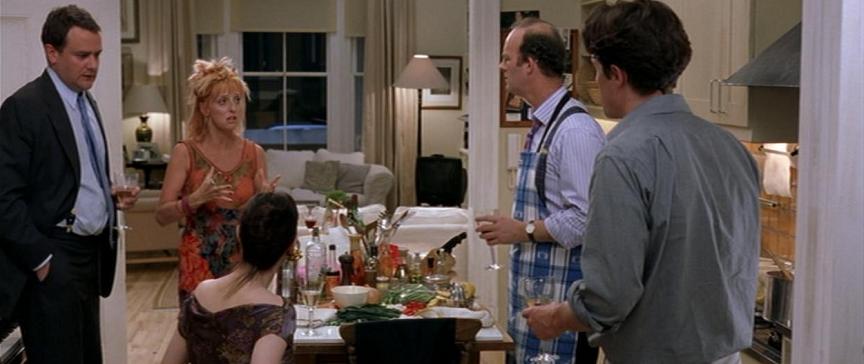
These friends aren’t just comic relief. They’re the emotional glue. They don’t demean each other for sport. They support one another without competition. They’re flawed, a little weird and fully human. And they show a kind of emotional generosity that’s become increasingly rare in film nowadays. There’s no need for anyone to posture. No toxic banter masked as love. Just people who’ve known each other for ages, who forgive easily and listen earnestly.
It’s oddly (and refreshingly?) utopian. Will’s best friend marries his ex-girlfriend, and it’s fine. They all still gather, still laugh, still show up. If the movie were made today, someone would have to be jealous. Spike, the wildcard roommate, would almost certainly be rewritten a bit creepier. But in 1999, it was enough for him to just be eccentric. In this world, people are allowed to be strange and lovable at the same time.
That’s the real draw of Notting Hill. Not the idea that a movie star might fall for a bookshop owner, but that your friends and family will always have your back. That you can be vulnerable without it being weaponized. That you can mess up and still be met with kindness.

A year ago, when I finally visited London, I made a pilgrimage to Notting Hill, certain I would find the bookshop from the film. And I did, or so I thought. I found the storefront, grinned like an idiot, and took photos with total confidence. I mean, it’s literally called The Notting Hill Bookshop. What else was I supposed to think?
It wasn’t until almost a year later that I discovered the actual filming location was somewhere else entirely and had long since been converted into a gift store.
Still, I don’t regret it. For that brief moment, I believed I was standing in the same place where Will met Anna. And honestly, maybe that’s the magic of Notting Hill. It doesn’t just make you suspend disbelief—it makes you want to.
Maybe that’s part of why 1999 remains my favorite year in cinema. It gave us The Matrix, 10 Things I Hate About You, Election, Being John Malkovich, Jawbreaker, Lock, Stock and Two Smoking Barrels, The Mummy, and yes, Notting Hill. All wildly different films capturing something distinct about that pre-Y2K moment when the world still felt a little more analog and possibility-rich.
And for all its glossy romance, the film leans into something quieter. There’s a confidence in the way it unfolds. No big twist or grand spectacle. Just two people trying to understand each other, surrounded by a group of people who, despite all odds, make life feel livable and maybe even lovely.
We talk a lot about which love stories are worth revisiting. But maybe it’s time we start asking the same of friendships.


 Danger Bowie
Leave a comment