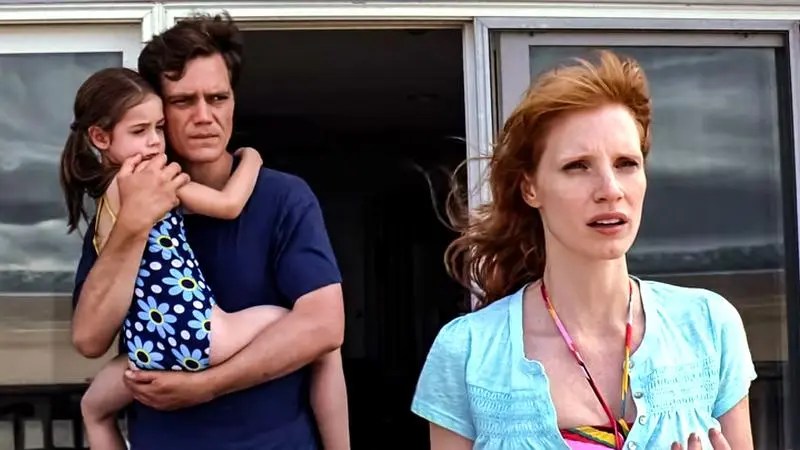
I just watched Take Shelter for the first time, and I’m honestly kicking myself for waiting this long. This film has hovered on my watchlist for the better part of a decade, but it finally jumped to the top after Michael Shannon called it his favorite performance during his Architectural Digest home tour (which, by the way, is a must-watch if you’re a fan of his work).
Set in rural Ohio, Take Shelter follows Curtis LaForche (Michael Shannon), a working-class construction supervisor and devoted husband and father. He’s living a modest life with his wife Sam (Jessica Chastain), who sells handmade goods at the local flea market, and their young daughter, Hannah, who lost her hearing after a bout of meningitis. The family is learning sign language together to better communicate, but just as they’re finding their rhythm, Curtis begins having terrifying, apocalyptic nightmares.
The dreams are intense and increasingly violent, featuring natural disasters, shadowy attackers and even loved ones turning on him. But he doesn’t tell anyone, not even Sam. Instead, he becomes consumed with a growing fear that something catastrophic is coming. He distances himself from his best friend and co-worker (the always awesome Shea Whigham), takes out a predatory loan they can’t afford to remodel a storm shelter in their yard.
Curtis’s inner world becomes more turbulent as the film goes on, and Shannon gives a haunting, layered performance that keeps you on edge. He plays Curtis with his signature intensity, perfectly encapsulating a man desperately trying to hold it together, terrified of what’s happening to him and even more terrified of what it might mean for the people he loves. You feel every flicker of fear behind his eyes. It’s the kind of performance that simmers rather than explodes, and when it does break open, it’s unforgettable.

Chastain, meanwhile, gives one of her most grounded and emotionally resonant performances. Watching her try to decipher what’s happening to her husband and figure out how to hold their family together gives the film its emotional backbone. The chemistry between them feels real and lived-in, which only adds to the tension as Curtis becomes more erratic.
Since Curtis is around the age his mother was when she was diagnosed with paranoid schizophrenia, he presumes that he’s inherited her illness. He seeks help at a local clinic, but can’t afford proper psychiatric care. One of the film’s most cutting undercurrents is how the mental health system fails people, especially working-class families, who are trying to do the right thing with almost no resources.

Jeff Nichols doesn’t sensationalize Curtis’s breakdown. The story is told with restraint and a deep understanding of class, pride and fear. Take Shelter walks a tightrope between psychological drama and slow-burn thriller, never tipping too far into cliché or exploitation. And it’s beautifully shot, often using gray skies and flat Ohio landscapes to reflect the unease settling into Curtis’s life.
The final scene is divisive, and I won’t spoil it here, but for me, it reinforces the film’s core themes and transforms Curtis’s terrifying solitude into something shared, something survivable. It’s the first time his family truly sees what he sees, and the implication is powerful: He’s no longer alone in the storm.
Take Shelter is a masterclass in character-driven storytelling. Anchored by two powerhouse performances and a script that never underestimates its audience, it’s one of the best films I’ve seen about mental illness and the desperation that lives in the margins.
If you haven’t seen it yet, don’t wait as long as I did.


 Danger Bowie
Leave a comment