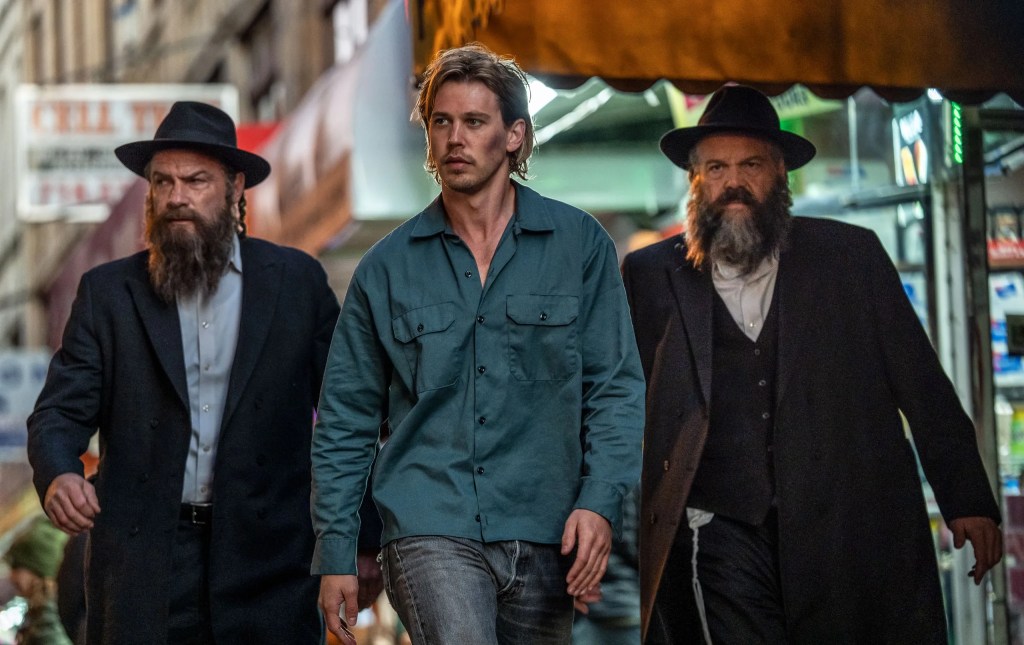

This past week felt like a little movie miracle. I saw Black Swan in IMAX for its 15th anniversary, finally watched Scorsese’s After Hours, and then capped it all off with Darren Aronofsky’s thrilling new crime caper Caught Stealing. Off the trailer alone, the film looks like Aronofsky’s take on a Guy Ritchie gangster romp. In reality, it’s darker and more character-driven.
The film follows Hank (Austin Butler), a washed-up baseball star-turned-bartender who mostly wants to be left alone with his drinks, his Giants, and his mom. But when his obnoxious punk neighbor, Russ (Matt Smith), asks him to cat-sit on a whim, Hank finds himself dragged into a world of impatient gangsters and endless threats of violence.
Every decision he makes hurts someone he loves, and every beating leaves him more battered and bruised. It all unravels over a couple of days in 1998 New York, which means this is a period piece (and I am a million years old).

The film feels like a major turning point for Butler. After Elvis made him a star and Dune: Part Two proved he could weaponize his charisma, Caught Stealing feels like the role that cements Butler as a true-blue movie star. (It could also tip him into his Brad Pitt-in-Fight Club era. Get on it, Fincher!) Hank is kind and broken, and Butler makes you believe every second. The violence is punishing, and in Dolby, the sound design makes every punch and kick reverberate through your body. You want to look away, but don’t because Butler sells it so hard.
As usual, I did my post-viewing homework and compiled eight bits of trivia to share with you to hopefully enhance your viewing experience. Enjoy!
1. The Almost 20-Year Road to Adapting Caught Stealing
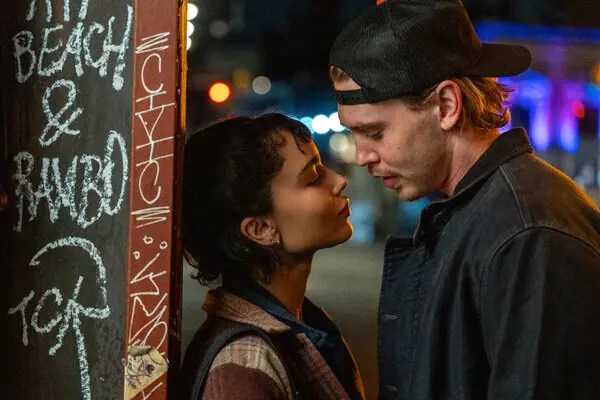
Around 16 years ago, Charles Huston and Aronofsky had an early conversation about adapting his debut novel, but Huston was in the middle of adapting The Mystic Arts of Erasing All Signs of Death for Alan Ball, so Caught Stealing didn’t move forward.
Years later, Huston dusted off his script and brought it back to Aronofsky. “I had done a very close one-to-one mapping of the book to the screenplay,” Huston told the Mystery Tribune. “I had streamlined a lot of elements to make it play better. And I really tightened it up. It was a very quick ninety-something-page, lean and mean screenplay.”
Since then, Huston says he doesn’t even really associate his script with the novel anymore. “I’ve never been precious about adaptation,” he said. “Whether I’m adapting someone else’s stuff or my own, or somebody else is adapting mine. My feeling is that I took what was in my head and my heart, and I put it in the book. And nothing’s gonna change [that].”
2. A Shot From Requiem for a Dream Helped Bring 1998 Coney Island to Life

For Caught Stealing, Aronofsky reunited with cinematographer Matthew Libatique, who first captured Coney Island’s grit in Requiem for a Dream. Because the film is set in 1998, they leaned on their earlier work in Requiem to guide the look and feel of Coney Island at the time.
Sequences from Requiem were referenced and recreated to make the setting feel authentic, linking Hank’s spiral to the same haunted landscape where Harry endlessly dragged that damn TV back and forth.
3. Austin Butler Transformed His Body for the Role
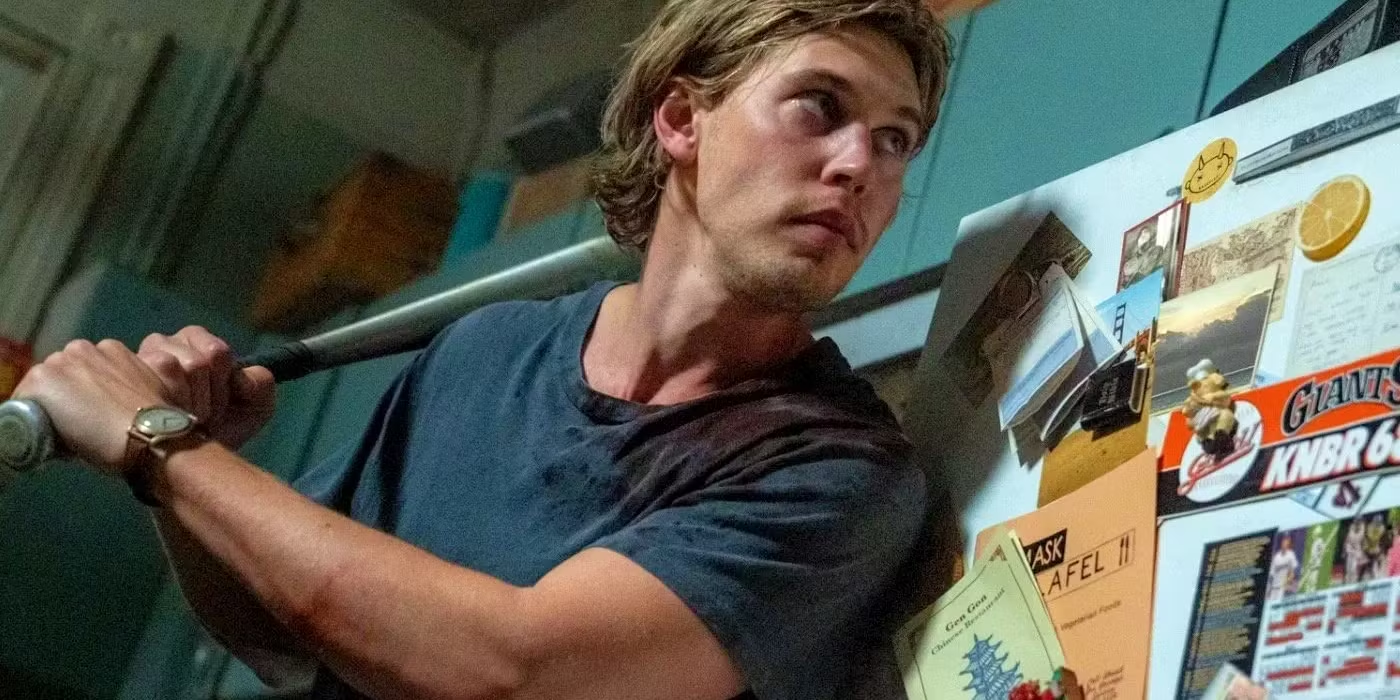
Butler gained 35 pounds to play Hank, a former baseball star-turned-bartender. He trained with celebrity coach Beth Lewis, doing “a ton of hip thrusters” to build the “perky buttocks” that baseball players are known for.
At the same time, Aronofsky wanted him to look like he’d been drinking for years, so Butler crushed pizza and beer to soften his edges. He went from 150 pounds to 185 in six months, later admitting to Men’s Health, “I’ve got a whole section of Celine pants that I just can’t even wear anymore.”
4. Aronofsky and Libatique Got Creative with Drone Shots

Two of the most jaw-dropping shots in the film use drones: one where Hank scrambles across a fire escape to evade two gangsters, the other during the climactic chase that flies the camera directly through the iconic Unisphere in Queens.

5. ‘Bud’ the Cat Is Already a Movie Star IRL

Hank’s unlikely companion, Bud, is played by Tonic the cat, who has a legit Hollywood résumé. Tonic previously played Dewey in Eli Roth’s Thanksgiving and was one of the eight “diva cats” who brought Church, the undead feline, to life in 2019’s Pet Sematary. So Tonic the cat is basically a horror icon.
6. Every Character Has a Spotify Playlist
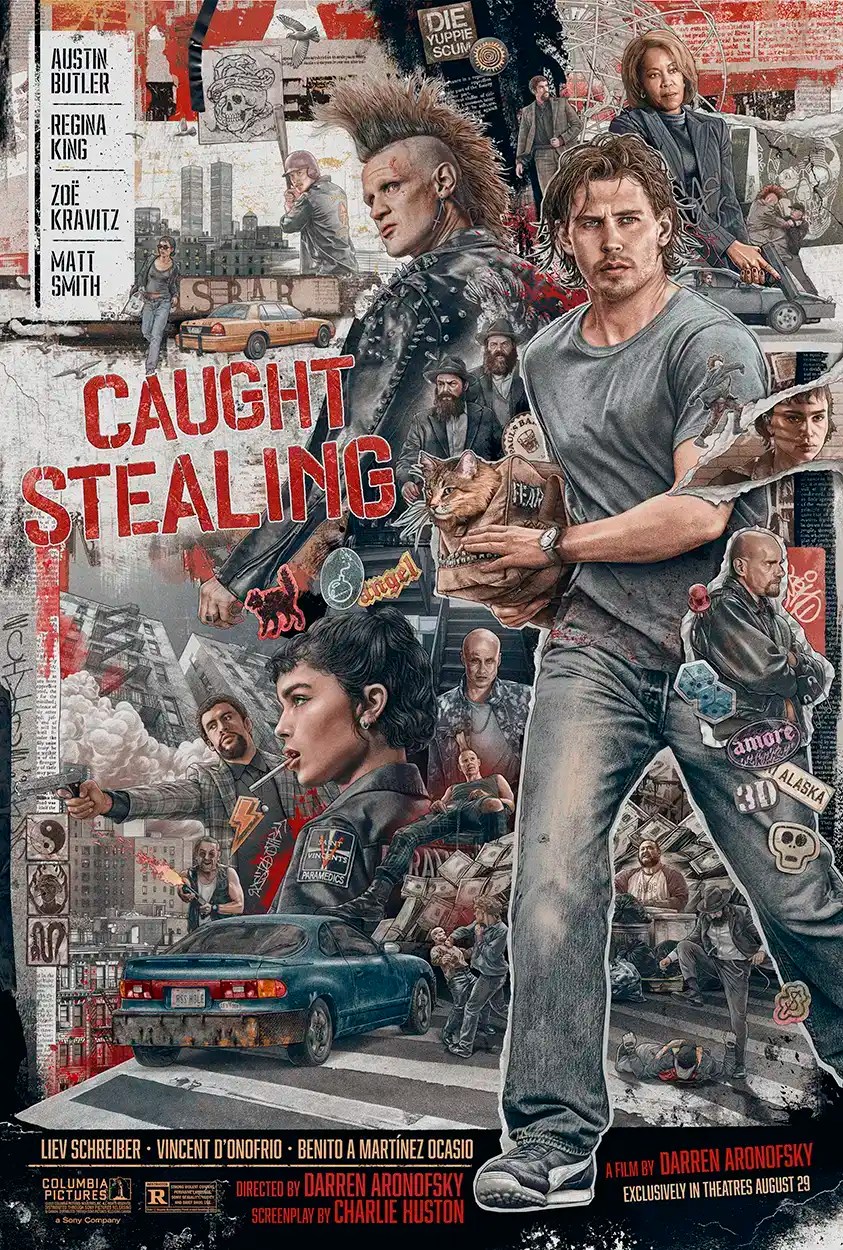
Music supervisor Jen Malone (Atlanta, Euphoria) built playlists for each character for the film’s promo campaign, then shared them with Aronofsky.
They’re now live on Spotify, and there are a lot of ’80s and ’90s bangers across the board, from punk to alt rock to hip-hop and R&B. Aronofsky has said his personal favorite is Russ’s playlist, which is punk-forward, perfect for Hank’s notorious neighbor. Check ’em out below:
And while you’re listening to those, head over to the film’s website. It’s seriously dope, and I wish more movies put this much love into their marketing materials. There’s key art, a map of the story, character bios and some historical facts about NYC in ’98.
7. It’s an After Hours-Inspired Love Letter to New York With an Appearance by Griffin Dunne
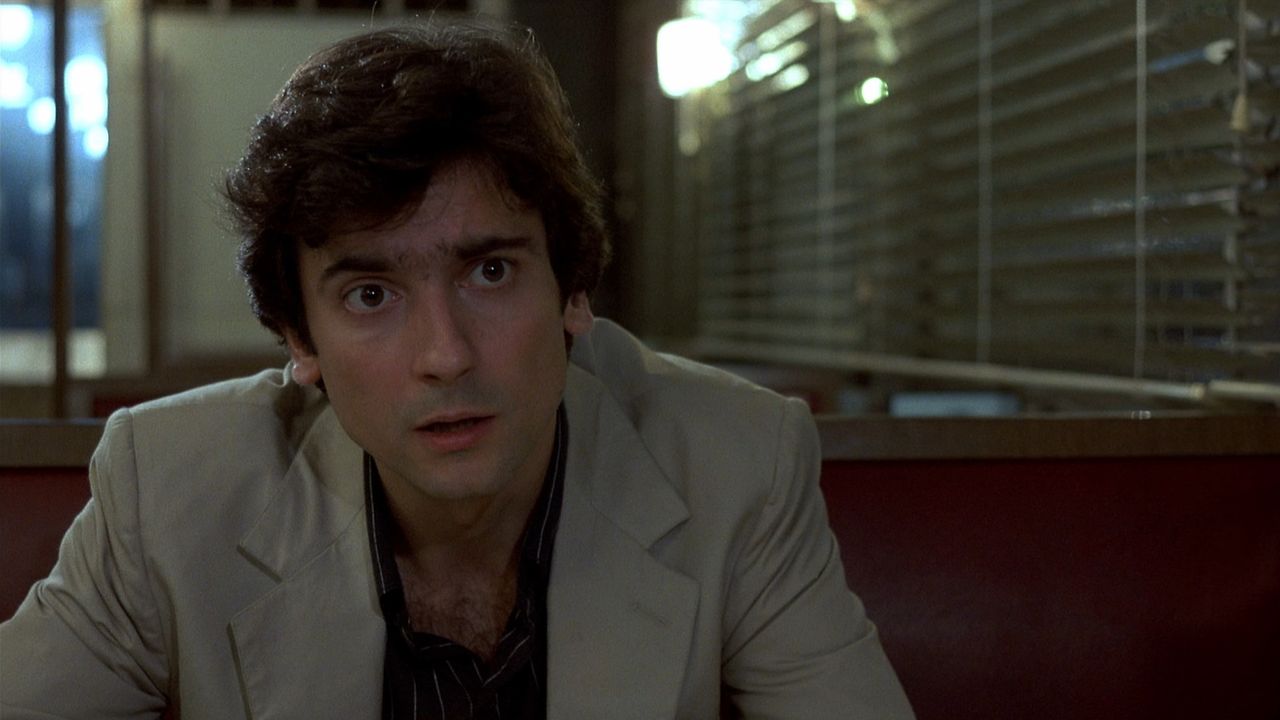
Like Scorsese’s After Hours, Caught Stealing traps a regular guy in a spiral of anxiety, bizarre encounters and escalating violence over a crushing couple of days. (After Hours takes place over one insane night.) Aronofsky admits the casting of Griffin Dunne as Paul (the same name as Dunne’s character in After Hours) was actually a coincidence. But there’s no denying the inspiration.
In an interview with The Wall Street Journal, Aronofsky calls the film a “love letter to New York.” That kinship extends to Aronofsky’s friend Spike Lee, who just released his own New York valentine with Highest to Lowest. And as an added bit of trivia, both films share the same cinematographer, Matthew Libatique.
8. From Requiem to Caught Stealing: Stanley Herman Keeps the Tradition Alive

There’s one actor who has appeared in Darren Aronofsky’s work more than anyone else: Stanley B. Herman, now 92. Aronofsky first met Herman in the ’90s when he was a film student and cast him in a short called The Pervert, a role that set the tone for most of Herman’s later appearances in his films. Since then, Herman has turned up in films like Black Swan, Mother!, and, of course, Requiem for a Dream, where he played Uncle Hank, the villainous man who chants “ass to ass.” (shudders) He jokes he’s recognized for that line so often he might as well put it on his gravestone.
In Caught Stealing, Herman appears again for a quick cameo, this time referencing baseball great Gil Hodges. In an interview with Pablo Torre, the director says the studio was desperate for him to cut the line, thinking modern audiences wouldn’t recognize Hodges, but Aronofsky fought to keep it in. It’s a super-quick moment that keeps Herman’s streak alive (but he doesn’t play a perv in this one).

 Danger Bowie
Leave a comment