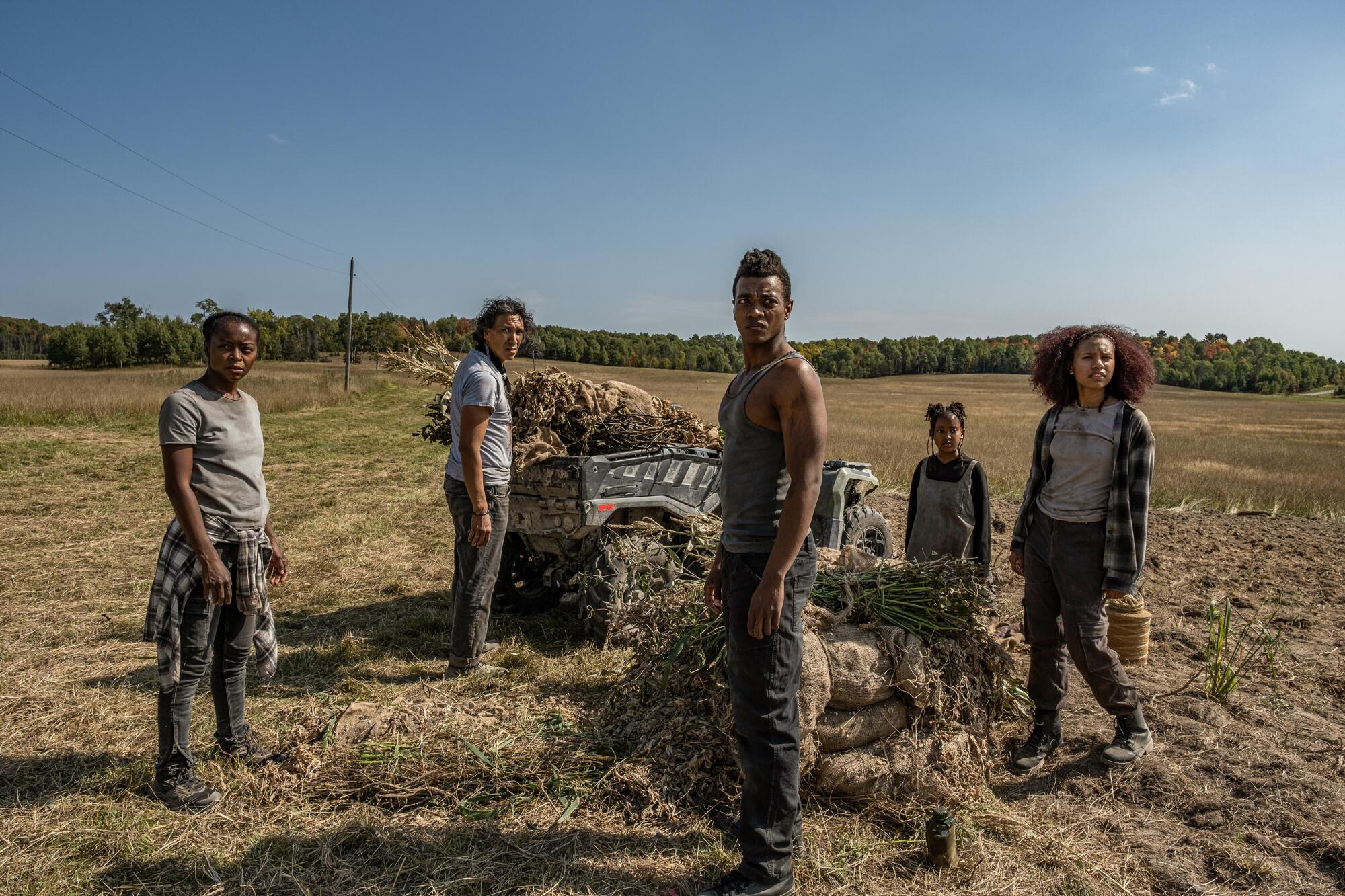

They say art reflects the times, and R.T. Thorne’s 40 Acres feels like both a warning and a reclaiming. While post-apocalyptic stories continue to flood the screen, 40 Acres stands out through its cultural specificity and emotional clarity. This is a dystopia shaped by Black American and First Nations survival legacies, where the most precious resource is land. And in the aftermath of climate catastrophe and civil war, we meet a family fighting to hold onto a land inheritance their ancestors carved out in freedom—and that others still want to take.
Hailey Freeman (Danielle Deadwyler) is the anchor of that world. She’s a former U.S. soldier now living on a generational farm in rural Canada with her partner Galen (Michael Greyeyes) and their blended family. Fourteen years have passed since a fungal pandemic wiped out most animal life, leading to famine and the slow collapse of society. The Freemans have created a home fortified with fences and firearms, where they can practice their rituals and protect the memories of their ancestors.
Their homestead runs on discipline, education and deep respect for the land. And these values are constantly tested by outsiders, raiders, cannibals and the creeping sense that any moment of calm is temporary.
Deadwyler brings a grounded, commanding presence to Hailey. She’s equally tough and fiercely loving. In a post-screening Q&A, she explained how the role connected to her own past: spending summers on her grandparents’ land, gardening and navigating everything without streetlights. “That kind of forest, woodsy dynamic really spoke to me. I was digging into my own family’s history.”

That sense of rootedness runs through every aspect of Hailey’s parenting and leadership. She trains her children in self-defense. She assigns them book reports on revolutionary texts like The Proletarian’s Pocketbook and Parable of the Sower—the latter a nod to Octavia Butler’s prophetic novel, in which survival depends on adaptability and vision. 40 Acres pulls from that same tradition, thematically and spiritually. The Freemans are sowing something for the future.
Hailey’s eldest son Emanuel—nicknamed Manny, played by Kataem O’Connor—is central to this tension between past and future. Now a young adult, he’s beginning to question his mother’s authority and the strict boundaries of their life. His desire to explore the world beyond the farm, and his budding romance with a stranger, bring risk to the family’s fragile safety. But his rebellion also opens the door for the film’s deeper questions: What do we pass down? What do our children owe us? And when is protection indistinguishable from control?
We’ve seen apocalyptic survivalism before, but not like this. Not with Black Americans and First Nations peoples at the center of the story, not as side characters or archetypes, but as fully realized culture-keepers with history and purpose. That specificity is part of what makes 40 Acres so special. The film reminds us that any future worth building depends on both knowledge and culture.
Galen, played with warmth and quiet strength by Greyeyes, grounds the family in Cree language and agrarian rituals. He’s shown as nurturing and wise, often balancing Hailey’s strict survivalist approach with a gentler, more spiritual connection to the land and their heritage.

The moment when he discovers his daughters eating old fast-food condiment packets is played for humor: He flies into a passionate rage, expressing dismay that they’d ingest such chemically laced, non-nourishing foodstuff. It’s one of the few comic beats in a largely somber film, and it adds dimension to both his character and the family’s dynamic.
The title 40 Acres evokes the historical promise of reparations after slavery, a debt that was never fully paid. For Hailey, that promise lives on through the land she stewards. It is her sacred inheritance: hard-won and always under threat.
In conversation, Deadwyler shared a piece of wisdom a friend once offered her: “Take your time with the land. Be patient with the land. The land will tell you what it wants to do — not the other way around.” That sensibility flows through Hailey’s parenting too.

Throughout the film, survival takes many forms: from physical to emotional to ideological. There’s the struggle to maintain safety, but also to raise children with integrity, to resist exploitation, to hold onto language and culture in a landscape built on erasure.
As Deadwyler put it, “I don’t think motherhood is always sweet and adoring… We have all of our facets. Motherhood has it, Black womanhood, Black motherhood has it, and I’m keen on showing the full spectrum. Hailey can be loving, playful, brutal, and deeply aware. She’s an agape kind of partner, balancing the masculine and the feminine with Galen. She has a reverence for history, shares survival knowledge, and leads with purpose. That may make her seem hard, but she’s doing what she has to do for the wellness of her family.”
That same clarity runs through the film’s more symbolic threats. Even the danger of cannibalism operates on more than one level. Yes, it’s literal, but it also speaks to the systems that consume people’s labor, bodies, and spirit. “People want to take your blood, flesh, and tears,” Deadwyler said. “That has to be resisted deeply, rigorously, continuously.”

40 Acres is a unique entry in a never-ending line of dystopian films, but it deepens the genre tropes that we’ve all become all too acquainted with. Thorne builds a world where land is legacy, resistance is ritual, and survival is collective. The film asks: Who gets to keep their history? Who gets to define the future? And whose stories endure when the systems fall apart?
At a time when so many stories about the end of the world feel interchangeable, 40 Acres asserts something urgent: Black and Indigenous families—their wisdom and their traditions—aren’t side notes in apocalypse. They are the blueprint for what comes next.
Deadwyler described her role as executive producer as “a form of mothering — the verb.” That same ethos pulses through every scene of the film. From the soil to the soul, 40 Acres is rooted in survival and insists on legacy.
Watch the Q&A
After a special screening of 40 Acres at AMC Century City on July 3, Danielle Deadwyler joined the audience for a post-film conversation about building the character of Hailey Freeman, honoring generational memory, and producing a film rooted in survival and spirit.



Leave a Reply